
Lamas Finance: A DeFi Treasure in the Solana Ecosystem

ABSTRACT
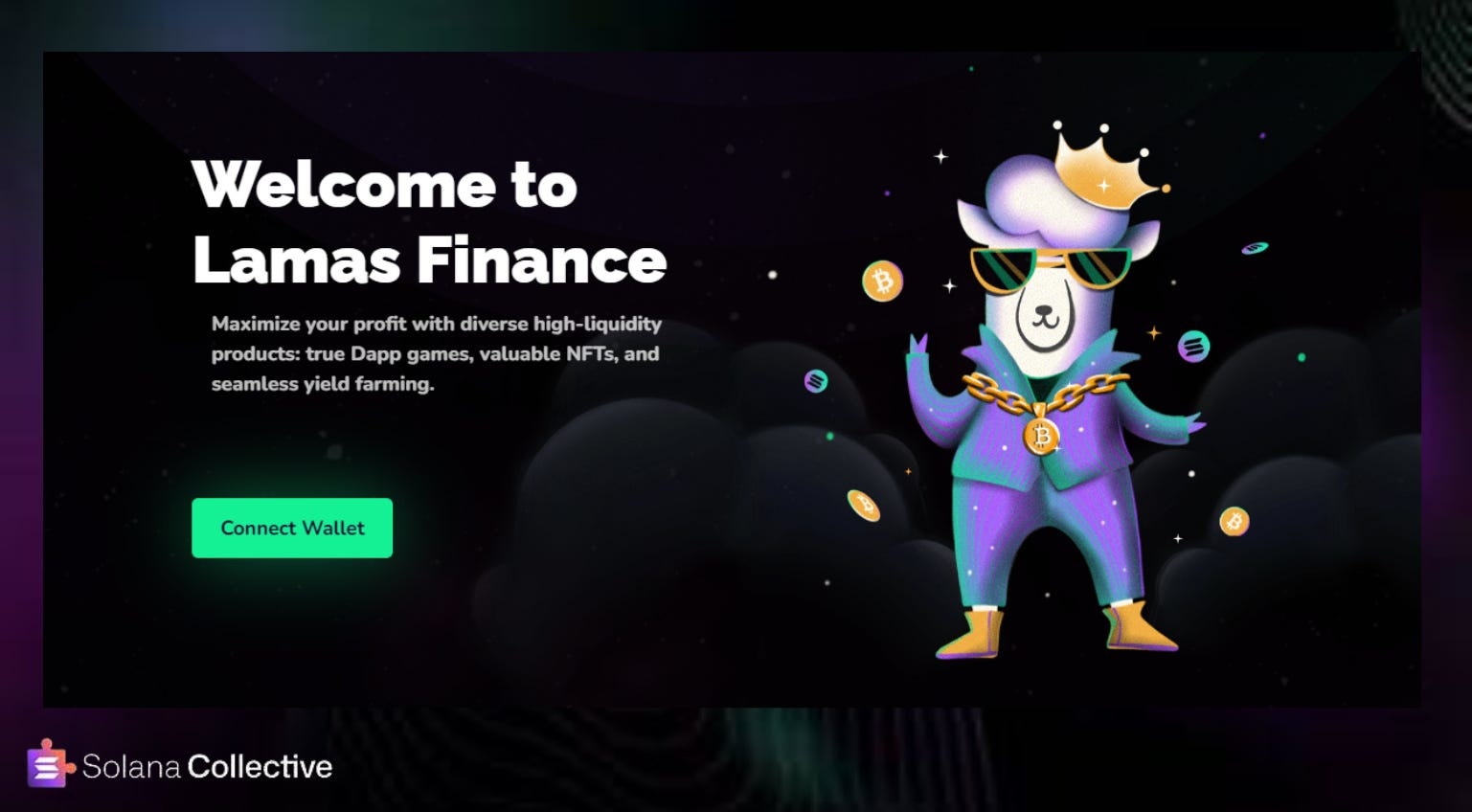
Lamas Finance is a DeFi platform built on the Solana blockchain that focuses on providing innovative financial solutions. It aims to enhance user experience by offering fast, secure, low-cost transactions. Solana's high throughput and minimal fees, Lamas Finance facilitates various financial services, including lending, borrowing, and yield farming. The platform emphasizes accessibility and efficiency, catering to both novice and experienced users in the crypto space. By utilizing advanced technology, the mass adoption of decentralized finance empowers users with greater control over their financial assets.
HISTORY OF SOLANA
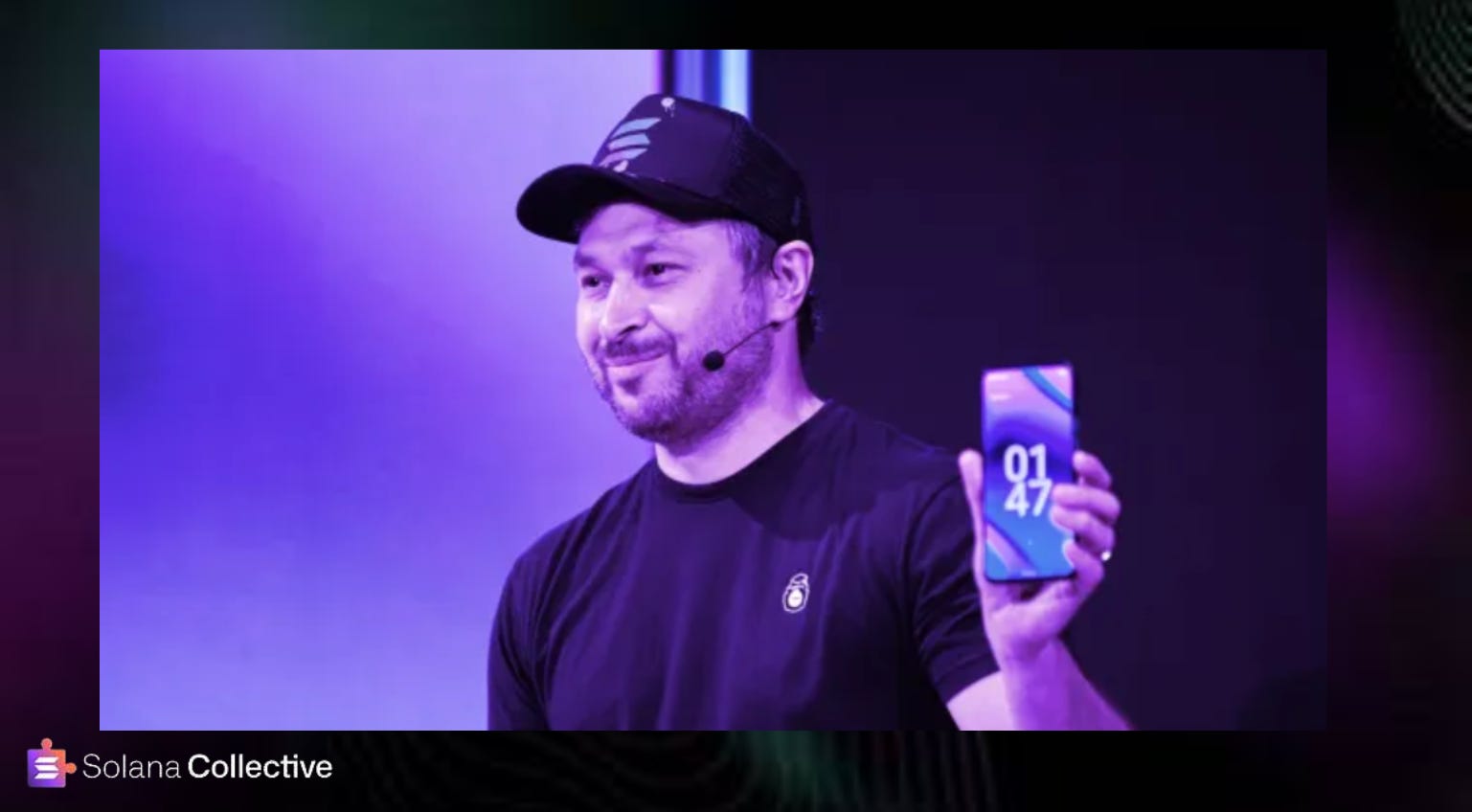
The origin story of Solana dates back to November 2017. Co-founder of Solana, Antoly Yakavenko came from a telecom background. His previous experience of designing distributed systems at Qualcomm, Mesosphere and Dropbox got him bumped into a new way for computers in a network to agree on the time, even if they don’t trust each other. He observed that big blockchains like Bitcoin and Ethereum, were peaking at 15 tps while their centralized competitor like Visa was processing a whooping 65,000 transactions per second at its best. Without a reliable clock, it was clear that there was no way blockchain could overcome the bottleneck of speed for mass adoption. In fact, he was so sure that when he solved the problem of syncing time between untrusted networks, he believed that a decade of research into distributed systems would create a network, which would be nothing like what existed back then, but a massive 10,000 times faster.
He named it as Proof of History and published a whitepaper.
Anatoly started the implementation in good ol’ C language. That was when Anatoly’s old mate from Qualcomm, Greg Fitzgerald, popped up with the idea of giving Rust a shot. He was sure that given Rust’s safety guarantees and speed, it would match up to C without breaking a sweat. Not more than two weeks later, Anatoly had the whole shebang shifted to Rust. He called it the Project Loom.
In June 2018, the team took their tech to the clouds. By July 19th, they had 50 node public, permissioned testnet up and running, handling bursts of 250,000 transactions per second like it was no big deal. Fast forward to December, they launched v0.10 Pillbox, a permissioned testnet with 150 nodes on Gigabit network, processing 200,000 tps on avg and peaking at bursts of 500,000 tps. They even added support for on-chain programs written in C, running smoothly in a safe environment called SBF. 2019 was the year for Solana to buckle up their seatbelts, build their infrastructure and get ready to take off. By July 2019, Solana had raised around $20M in private token sales. In the first half of 2019, Solana devs launched a bunch of releases, tests and audits to strengthen the network, increasing and experimenting with more optimal ways to shoot the throughput of the system.
Q3 of 2019, other than closing in convincingly on fundraising, would be remembered for launch of first publicly incentivized testnet, Tour De Sol, and first iteration of “No Sharding- The Solana Podcast” which is now renamed as “Validated”
Solana made some significant moves and leaps in the engineering realm in 2020. As a network and as an open source project. Official soft launch of Solana mainnet had happened by early 2020.
By the end of 1st quarter, they officially initialized mainnet beta with the help of validators across the world. In less than a year, the network processed over 8 billion transactions and assembled over 300 validators worldwide and haven’t stopped building at breakneck speed ever since.
What was new with Solana?
Solana, at its core, was designed to be accessible for mainstream use by maintaining and shaping an architecture, with scalability and efficiency at the center of it.Engineering a blockchain for mainstream adoption requires user-friendly experience, and ease of experimentation with the technology. These values give Solana a leading edge of choice over many other major blockchain players.
Those who talk big should walk big. If someone had to go tip-toe with the elephant in the room and stay competitive to bigger chains like Ethereum, there must be some aspects they should aim to be better at.
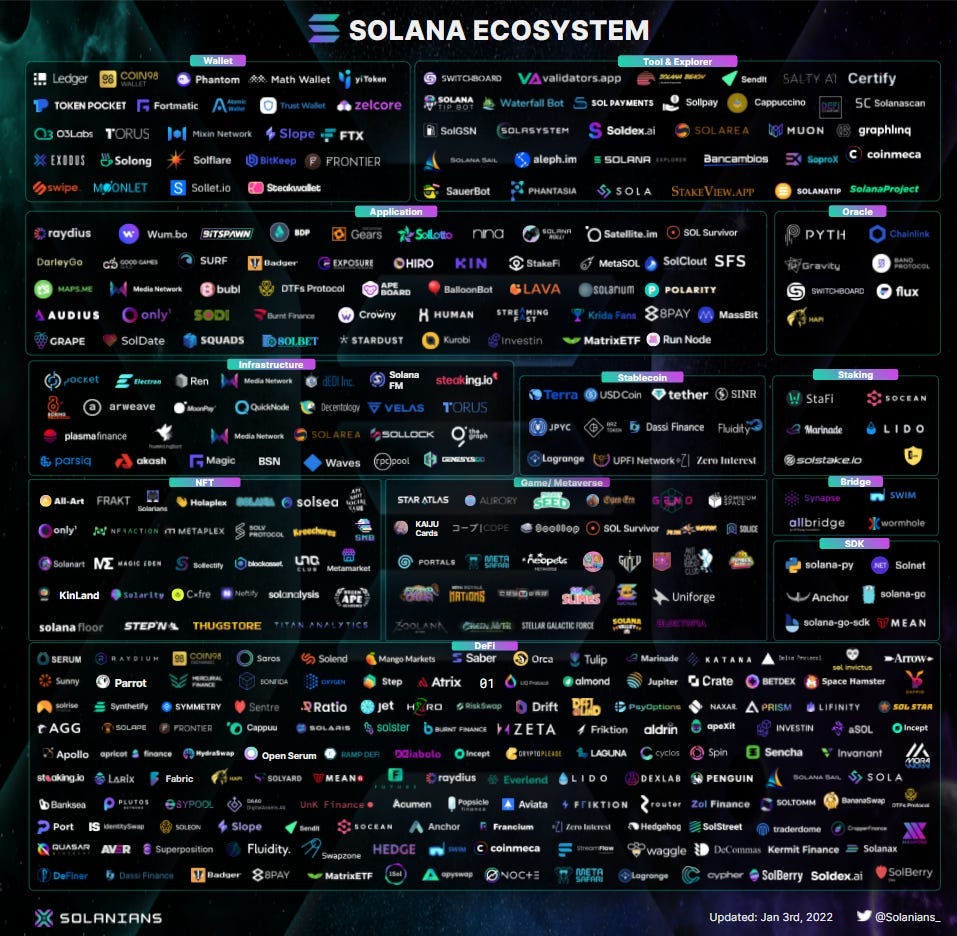
These were some key innovations made by Solana which set them apart from other blockchains, their USPs, in order to create a decentralized, permissionless network which set them apart from other blockchains.
Proof of History
Consensus algorithm which Solana was built on top of, as described by Anatoly in his whitepaper, was a unique solution to the problem pre-Solana era blockchains faced. Commanding time over a clock.
How does Lamas Finance integrate with Solana's ecosystem?
Lamas finance is not directly related to Solana blockchain. Solana is a high-performance blockchain network that is gaining traction in the DeFi space due to its fast transaction times, low fees, and growing adoption by developers and enterprises. Some key points about Solana:
Solana can process around 65,000 transactions per second, much faster than Ethereum's 15 TPS
Solana has seen a surge in DeFi TVL, growing to around $4.4 billion as of early 2024
Major developments include Visa using Solana for USDC settlements, Solana Pay integrating with Shopify, and the upcoming Firedancer upgrade
However, Solana has also faced some challenges like network outages and the fallout from the FTX collapse, which impacted its token price
It integrates with Solana's ecosystem by providing self-custodial and yield-optimized strategies for users within the DeFi space. Recently, Lamas Finance announced support for Solana, becoming one of the early partners to integrate Webacy's safety features, which enhance user security by assessing the risk of connected wallets through proprietary APIs.Additionally, Lamas Finance is collaborating with Inery to incorporate advanced Web3 technologies into its decentralized applications (dApps), further enhancing user experience and engagement within the Solana network. This integration allows Lamas Finance to leverage Solana's high-speed transactions and low fees, making it an attractive platform for DeFi activities.
INTRODUCTION
Lamas Finance is launched on the Solana blockchain, it aims to provide users with genuine blockchain gaming experiences while also offering essential DeFi functions. This history of Lamas Finance explores its development, features, and future plans.
Origins and Development
It was developed to meet the growing demand for decentralized applications (DApps) that combine gaming and finance. The project capitalizes on Solana's capabilities, which is known for its speed and low transaction costs, making it an ideal platform for high-performance applications. The core mission of Lamas Finance is to offer users a comprehensive experience that includes playing games, earning profits, and engaging in various DeFi activities.The platform's development began in 2021, with a focus on creating a user-friendly environment where players can enjoy blockchain games while also benefiting from DeFi functionalities. The team behind Lamas Finance aimed to ensure that all game logic and calculations are executed directly on the blockchain through smart contracts, ensuring transparency and fairness in gameplay.
What is Lamas Finance?
It is a DeFi platform that combines gaming and financial services. It offers various DApp games, including Price Prediction, Up or Down, Jackpot Lottery, and Lucky Spinner, where users can engage in fun, interactive experiences while earning rewards. The platform influences smart contracts on the Solana blockchain, ensuring that all transactions and game mechanics are transparent and secure. The main mission of Lamas Finance is to create a user-friendly environment that not only entertains but also empowers users to maximize their profits through new and unique financial products. By making the experience in gaming, Lamas Finance attracts a large audience, including those who may not be interested in traditional financial services.
Challenges solved by Lamas finance
One of the major issues solved by Lamas Finance is the complexity and unease in access of DeFi products. Many users find it difficult to navigate traditional financial services and investment opportunities in the crypto world. Lamas Finance eases this by combining gaming elements into its products, making the experience more enjoyable for new users. Moreover, Lamas Finance handles the problem of liquidity in DeFi, by providing high-liquidity products, which ensures that users can easily enter and exit positions without serious slippage. This is particularly important in a rapidly fluctuating market where quick transactions can lead to major gains or losses.
Main features of Lamas Finance
Blockchain Gaming Hub: Built on the Solana blockchain, Lamas Finance provides a platform for true decentralized applications (DApps) that execute game logic and calculations via smart contracts.
Diverse Gaming Options: The platform includes various games such as Price Prediction, Up or Down, Jackpot Lottery, and Lucky Spinner, allowing users to earn profits and bonuses through gameplay.
Utility Token (LMF): The native LMF token is used for participating in games, staking, yield farming, exchanging NFTs, and governance functions within the ecosystem.
DeFi Functions: Lamas Finance integrates essential DeFi features, including massive liquidity pools, farming, and staking opportunities.
Roadmap for Future Development: Upcoming features include an NFT marketplace, lending protocols, and multi-chain support for enhanced user experience and accessibility.
What Makes it Different From Other Platforms?
True DApps: All games on Lamas Finance are considered true DApps, meaning they operate on the blockchain without any centralized control. This ensures that players have a fair and transparent gaming experience.
Variety of Games: The platform hosts a range of games, including:
Price Prediction: Players predict the price movements of cryptocurrencies.
Up or Down: A betting game where users wager on whether the price will rise or fall.
Jackpot Lottery: A lottery system that allows users to participate for a chance to win significant rewards.
Lucky Spinner: A game of chance where players spin a wheel to win prizes.
Utility Token (LMF): The LMF token serves multiple purposes within the ecosystem. Users can participate in games, stake their tokens, engage in yield farming, and even take part in governance decisions regarding the platform's future.
DeFi Integration: Lamas Finance combines gaming with essential DeFi functions, allowing users to earn profits through various financial activities. This integration helps to attract a diverse user base interested in both gaming and finance.
It Offers Various Blockchain game like :
Price Prediction: Users predict the price movement of a cryptocurrency within a certain timeframe and earn rewards based on the accuracy of their predictions.
Up or Down: A simple game where users bet on whether the price of a cryptocurrency will go up or down within a short time period.
Jackpot Lottery: A revolutionary lottery system that leverages blockchain technology to ensure transparency and fairness. All participants have an equal chance of winning the jackpot.
Lucky Spinner: A game of chance where users spin a virtual wheel for a chance to win various prizes and bonuses.
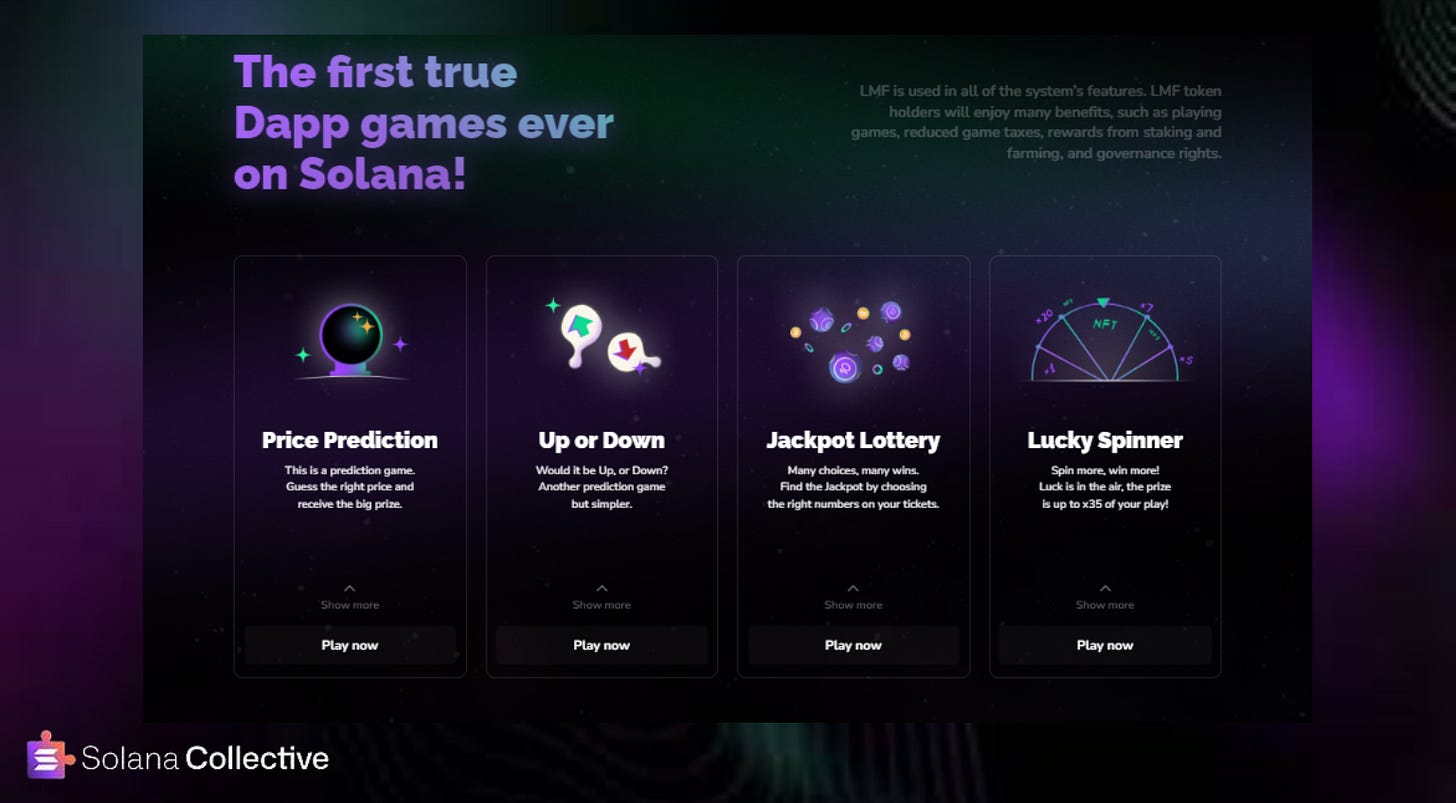
Dapp Games on Solana
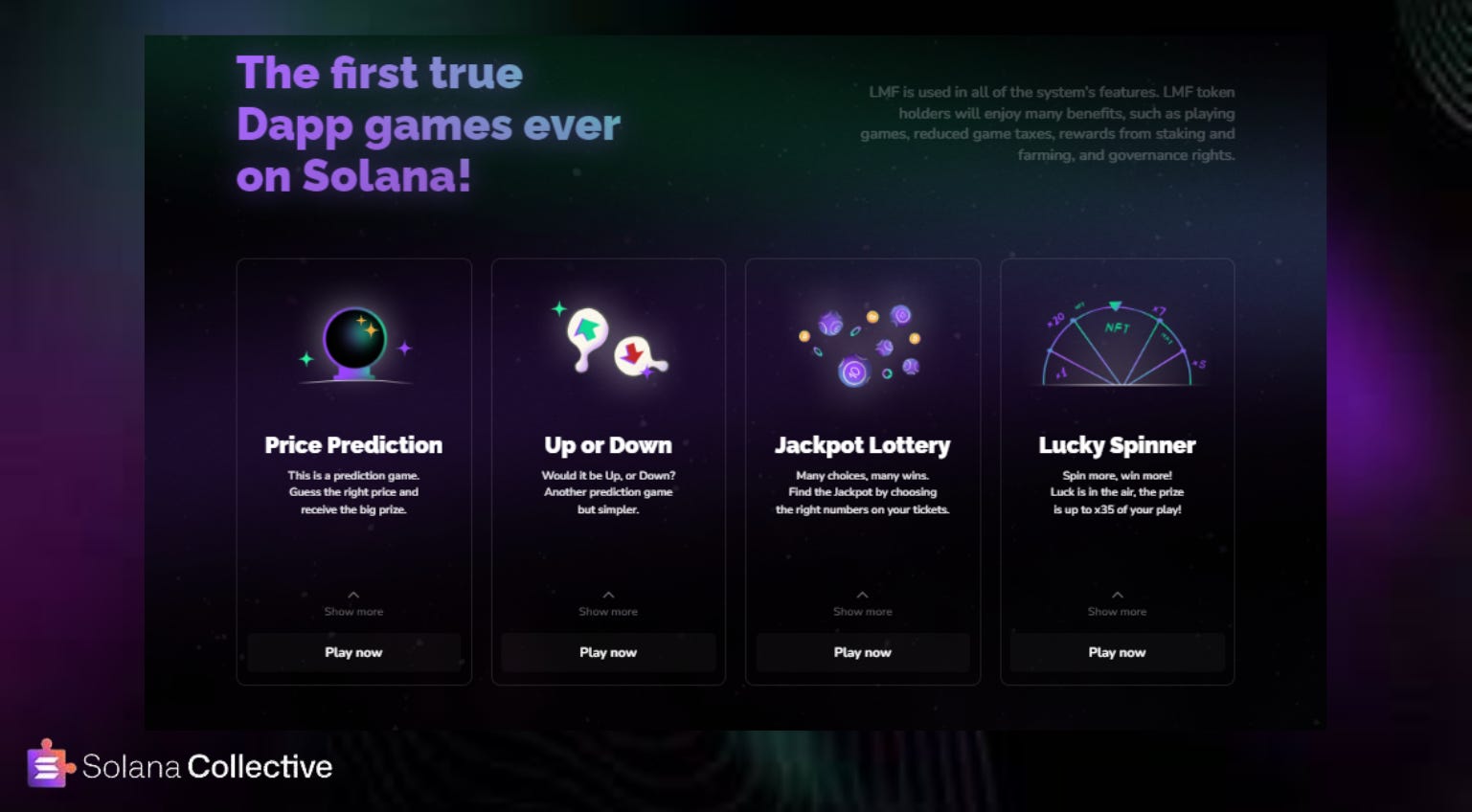
Upcoming updates In the games on Lamas Finance
Lamas Finance is expected to launch a new game in April, though the exact game is not specified.
The platform's roadmap includes the launch of various features such as a presale NFT collection, "Play to Earn NFT," NFT Marketplace, and lending protocols.
Lamas Finance also plans to support multi-chain functionalities for all games as part of its future development.
"Play to Earn NFT" system work
In-game assets are represented as NFTs: Items like characters, weapons, land, etc. are tokenized as non-fungible tokens (NFTs) on the blockchain. This gives players verifiable ownership of these digital assets.
Earning through gameplay: Players can earn rewards by completing quests, winning battles, progressing through levels, or engaging in other in-game activities. These rewards come in the form of the game's native cryptocurrency tokens or NFTs.
Tokens can be used or traded: The earned tokens can be used within the game's ecosystem, such as for upgrading assets, purchasing new items, or participating in governance. Players can also trade these tokens on cryptocurrency exchanges for other cryptocurrencies or fiat money.
NFTs can be bought, sold, or used: NFT assets earned or acquired through gameplay can be traded on NFT marketplaces. Players can sell them to other players for profit. Some games also allow using NFTs to enhance gameplay, such as equipping weapons or characters with special abilities.
Player-driven economy: The combination of player-owned assets and the ability to trade them creates a player-driven economy within the game. The value of these assets is determined by market forces of supply and demand.
Blockchain ensures transparency and ownership: Blockchain technology ensures that players have true ownership of their assets, which cannot be taken away or duplicated by game developers or other players. The transparent nature of blockchains also prevents manipulation of the in-game economy.
Advantages of the “Play to Earn” model
Real Earnings: Players can earn real money or valuable in-game assets like cryptocurrencies, tokens, and NFTs through gameplay. These can be sold on marketplaces for profit.
Player Ownership: Blockchain technology gives players true ownership of their in-game assets represented as NFTs. Players can trade, sell or transfer these assets.
Economic Opportunities: P2E games create virtual economies, providing learning opportunities for players as well as jobs for in-game entrepreneurs, developers and traders.
Accessibility: P2E games are open to a global audience, requiring only an internet connection and compatible device to participate.
Alignment of Incentives: P2E benefits both players who earn rewards and developers who generate revenue as the ecosystem grows.
Community Engagement: P2E encourages players to work together towards shared goals and rewards, fostering a strong gaming community.
Adoption of Blockchain: P2E is driving increased adoption of blockchain technology as more gamers are introduced to its applications.
Blockchain technology play in the success of Play-to-Earn games
Blockchain technology plays a crucial role in the success of Play-to-Earn (P2E) games by providing the infrastructure for secure, transparent, and decentralized ownership of in-game assets. Here are the key ways blockchain contributes to the success of P2E games:
True Player Ownership: Blockchain allows players to truly own their in-game assets, such as characters, items, and virtual land, represented as non-fungible tokens (NFTs). This ownership is verifiable on the blockchain and cannot be taken away by the game developers.
Earning Potential: P2E games enable players to earn real-world value through gameplay in the form of cryptocurrencies or NFTs. These earned assets can be traded on marketplaces for profit, providing an incentive for players to engage with the game.
Transparency and Fairness: The decentralized nature of blockchain ensures transparency in the game's mechanics and economy. Players can verify the scarcity and authenticity of in-game assets, reducing the risk of manipulation or fraud.
Interoperability: Blockchain enables the potential for interoperability between different games and platforms. Players could theoretically use their earned NFT assets across multiple games, enhancing the value and utility of their in-game items.
Scalability: For P2E games to thrive, they require a blockchain network that can handle high transaction volumes at low costs.
Security of in-game assets in Blockchain
Decentralization: In traditional gaming, assets are stored on centralized servers, making them vulnerable to hacks and data breaches. Blockchain, on the other hand, operates on a decentralized network where no single entity has control over the entire ledger. This means that altering any asset or transaction would require compromising multiple nodes in the network, making it significantly more difficult for malicious actors to manipulate data or steal assets.
Immutable Ledger: Once data blocks are added to the blockchain, they become immutable, meaning they cannot be altered or deleted. This immutability protects the integrity of in-game assets, ensuring that players' ownership records remain intact and secure from tampering. Any attempt to change a transaction would require altering all subsequent blocks, which is practically impossible due to the cryptographic security of the blockchain.
Cryptographic Security: Blockchain employs advanced cryptographic techniques to secure transactions and user data. Each transaction is verified through cryptographic signatures, ensuring that only authorized users can access or modify their assets. This high level of encryption protects against unauthorized access and fraud, safeguarding players' in-game items and currencies.
Consensus Mechanisms: Blockchain networks utilize consensus mechanisms to validate transactions. These mechanisms, such as Proof of Work or Proof of Stake, require participants to agree on the validity of transactions before they are added to the blockchain. This process helps prevent fraudulent activities, such as double spending, and ensures that only legitimate transactions are recorded, further securing in-game assets.
Transparent Ownership: Blockchain provides a transparent record of ownership for in-game assets. Players can verify their ownership of NFTs and other digital items through the blockchain, which enhances trust in the system. This transparency also allows players to trade or sell their assets on various marketplaces, knowing that their ownership is securely recorded and recognized across the network.
Protection Against Hacks: While blockchain itself is secure, the broader ecosystem must also be protected. Players are encouraged to use secure wallets and follow best practices to safeguard their private keys and passwords. By doing so, they can protect their assets from phishing attacks and other vulnerabilities that may target individual users rather than the blockchain itself.
What makes Lamas Finance stand out in the Solana ecosystem ?
Unique Gaming Hub : Lamas Finance is positioned as a true-DApp gaming hub, offering a variety of genuine blockchain gaming experiences. This includes games like Price Prediction, Up or Down, Jackpot Lottery, and Lucky Spinner, all of which operate on the blockchain through smart contracts, ensuring transparency and security in gameplay.
Integration of DeFi Functions : In addition to gaming, Lamas Finance provides essential DeFi functionalities. Users can engage in activities such as staking, yield farming, and participating in governance through the LMF utility token. This dual focus on gaming and DeFi creates a comprehensive ecosystem that appeals to a broader audience.
Leveraging Solana's Advantages : The platform benefits from the speed and cost-effectiveness of the Solana blockchain. Solana's high throughput and low transaction fees make it an ideal environment for gaming applications, allowing for a seamless user experience without the typical delays or costs associated with other blockchains.
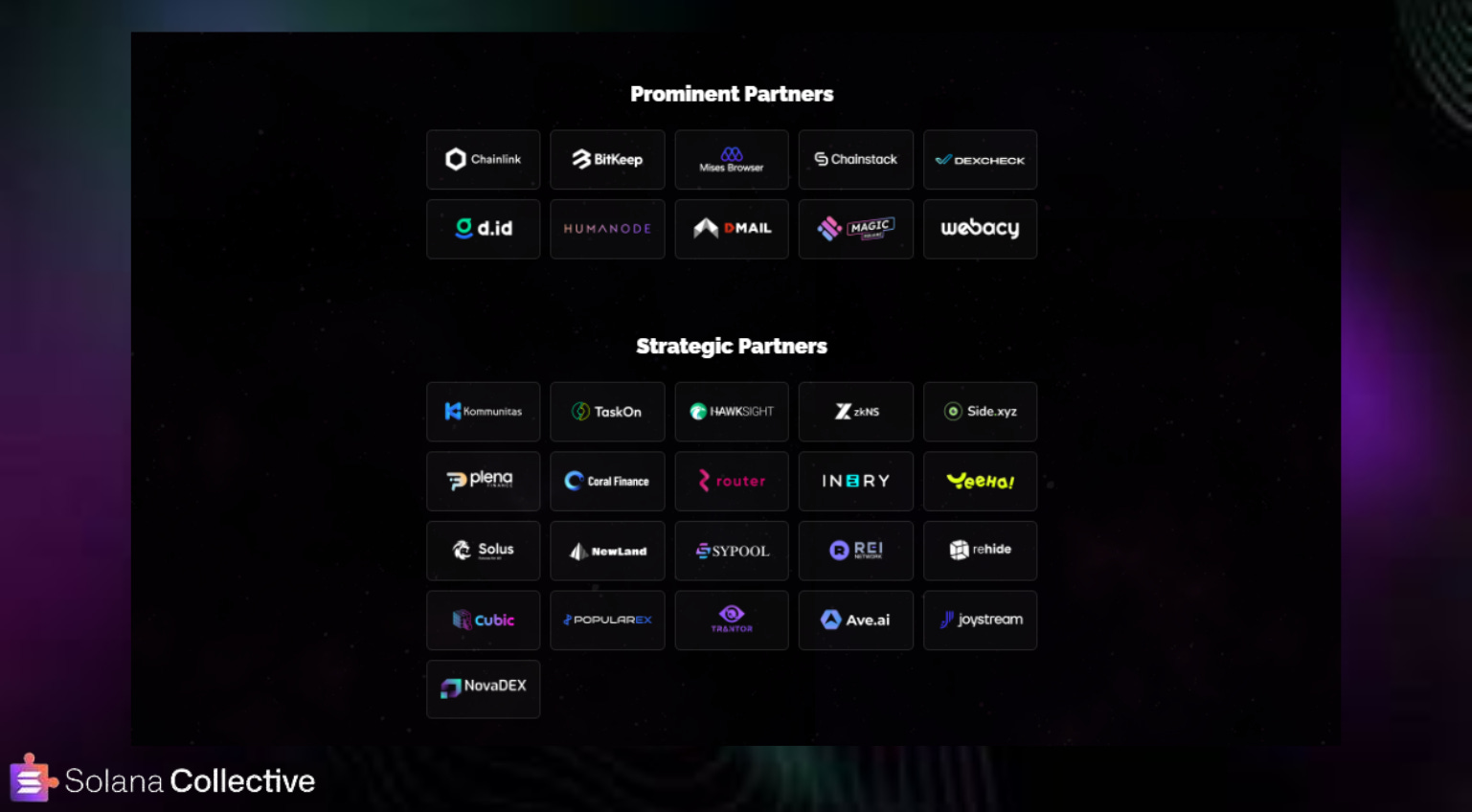
Strategic Partnerships : Lamas Finance has formed strategic partnerships, such as with PopularEx, to enhance its offerings and community engagement. These collaborations are aimed at driving innovation in blockchain gaming and decentralized finance, potentially introducing new features and improving user experiences.
Roadmap for Future Development : The roadmap for Lamas Finance includes plans for launching additional features like an NFT marketplace, lending protocols, and multi-chain functionalities. This vision for growth indicates a commitment to expanding its ecosystem and meeting diverse user needs.
NFT
NFT stands for Non-Fungible Token, which is a unique digital asset verified on a blockchain. Unlike fungible assets, such as currency, which can be exchanged for one another (e.g., a dollar bill for another dollar bill), NFTs are distinct and cannot be exchanged on a one-to-one basis. Each NFT has a unique identifier and metadata that distinguishes it from other tokens, providing proof of ownership and authenticity.
Characteristics of NFTs
Uniqueness: Each NFT is one-of-a-kind, representing digital or tokenized versions of real-world assets, including art, music, videos, and in-game items.
Blockchain Verification: NFTs are stored on a blockchain, which is a decentralized digital ledger. This technology ensures that ownership records are secure and tamper-proof, allowing for transparent transactions.
Ownership and Transferability: Ownership of an NFT is tracked through the blockchain, and while there can only be one owner at a time, NFTs can be bought, sold, or traded on various marketplaces like OpenSea and Binance NFT Marketplace.
Applications of NFTs
NFTs have gained popularity in various fields, particularly in digital art and collectibles. Notable examples include:
Digital Art: Artists can sell their work as NFTs, allowing them to retain ownership rights while also earning royalties on future sales.
Gaming: In-game assets can be represented as NFTs, enabling players to own, trade, and sell unique items within virtual worlds.
Real Estate and Other Assets: NFTs are being explored for tokenizing real estate and other physical assets, providing a new way to represent ownership digitally.
Market Trends
The NFT market exploded in popularity around 2021, with significant sales, including digital artworks fetching millions of dollars. However, the market is also subject to volatility, and potential buyers are advised to conduct thorough research before investing, as the value of NFTs can fluctuate widely based on demand and market trends.
NFT’s in Lamas finance
Lamas Finance appears to be a specific project or platform in the DeFi (Decentralized Finance) space that utilizes NFTs in its ecosystem. However, there isn't widely available detailed information about "Lamas Finance" as it may be a new or niche project.
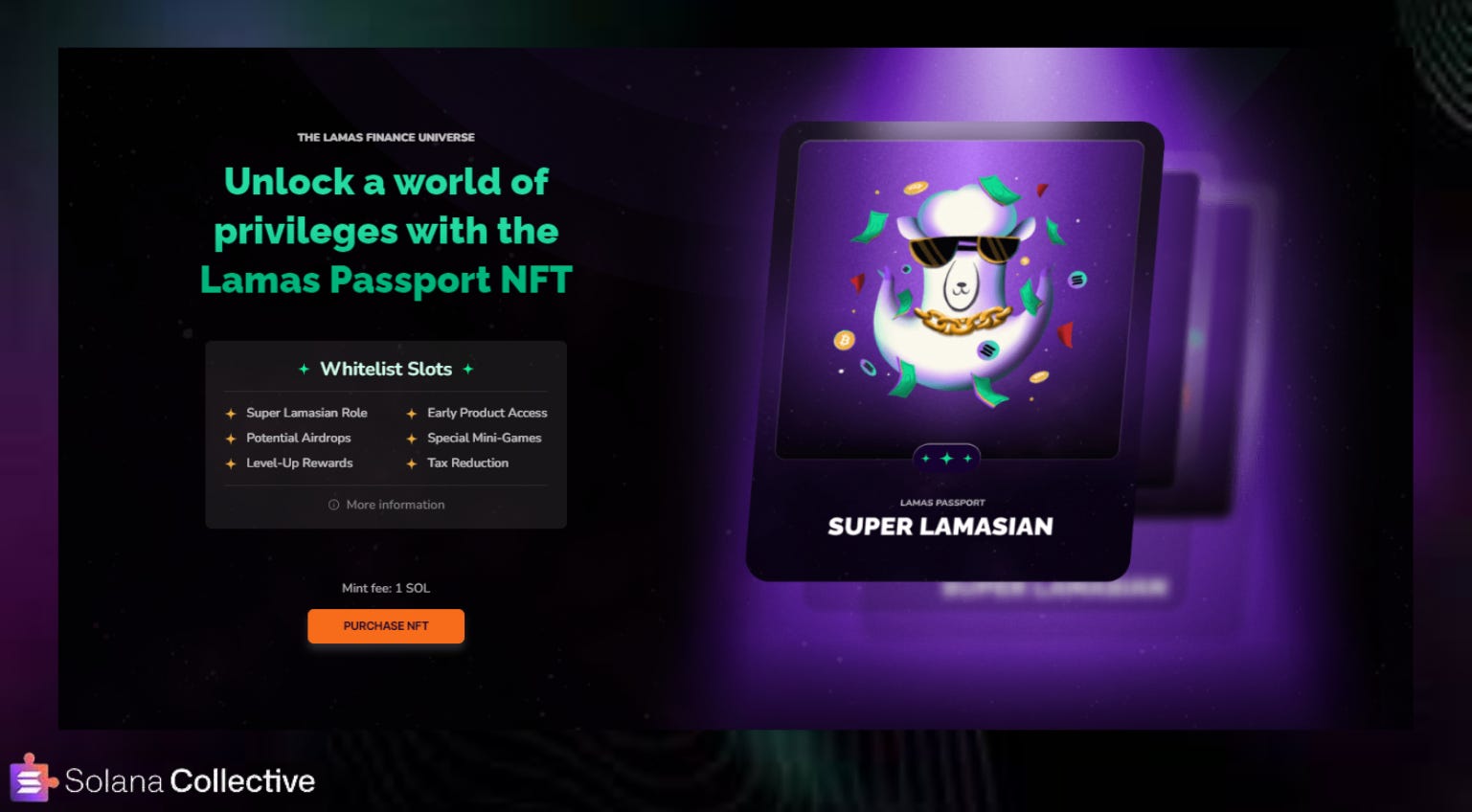
NFT Collections
Lamas Finance features four NFT collections, each corresponding to a different game, with a total of 72 unique NFT pieces. Each collection is represented by a single image divided into six parts, with each part available in three rarity versions (1, 2, or 3 stars). To complete a collection, players must gather all six pieces of the same rarity version.
The primary advantage of these NFT collections is that they enhance the gaming experience by integrating collectible elements with gameplay, allowing players to engage more deeply with the Lamas Finance ecosystem while also participating in decentralized finance activities.
Collecting
NFT collecting in Lamas Finance involves acquiring unique digital assets tied to various games within its ecosystem. Each collection features distinct NFTs that enhance gameplay and offer investment opportunities. Players can gather these NFTs, which are designed with attention to detail and rarity, contributing to a rewarding gaming experience.
The main advantage of NFT collecting in Lamas Finance is the integration of collectible elements with decentralized finance (DeFi) functionalities, allowing players to enjoy engaging games while also potentially benefiting financially from their NFT investments.
Redeeming
NFT redeeming in Lamas Finance allows players to exchange their complete NFT collections for rewards based on weekly themes. To participate, users must own a full set of six different NFTs from a selected collection. Once they meet this requirement, they can redeem their NFTs for various benefits, which may include in-game assets, tokens, or other rewards. The estimated rewards are tiered based on the rarity of the complete collection-
1-star collection: 100 LMF - 500 LMF
2-star collection: 500 LMF - 2000 LMF
3-star collection: 2000 LMF - 10000 LMF
The main advantage of NFT redeeming in Lamas Finance is that it incentivizes players to collect and engage with the platform's NFT offerings, enhancing their overall gaming experience while providing tangible rewards for their participation and investment in the ecosystem.
Burning
Burning an NFT in Lamas Finance refers to the process of permanently removing the NFT from circulation. This action is typically irreversible and is often done as part of a mechanism to earn rewards or to trigger specific platform features. Here’s how it works and why it might be done:
Permanent Removal:
When an NFT is burned, it is sent to an address that is not accessible or is destroyed via a smart contract function. This makes the NFT irretrievable and permanently removes it from the total supply.
Redemption for Rewards:
In Lamas Finance, players who own a complete collection (six different NFT pieces of the same collection and rarity) of the "theme-of-the-week" can choose to burn their collection. In return, they receive a valuable reward. The burning process ensures that these specific NFTs are no longer in circulation, increasing the scarcity of the remaining NFTs.
NFT Marketplaces
The NFT marketplace in Lamas Finance is a dedicated platform where users can buy, sell, and trade NFT pieces from various collections. It allows users to search for specific NFTs using filters such as collection type, card type, and rarity, facilitating a streamlined trading experience.
Key Features
User-Friendly Search: Users can easily find NFTs that meet their needs through various search filters.
Transaction Tax: Each transaction incurs a 5% tax on the NFT's value, with half going to the Lamas Treasury and the other half being burned.
The primary advantage of the NFT marketplace in Lamas Finance is that it provides a structured and efficient environment for trading NFTs, enhancing liquidity and accessibility for collectors and players within the gaming ecosystem. This integration of NFTs with the DeFi functionalities of Lamas Finance allows users to maximize their engagement and potential returns in the platform.
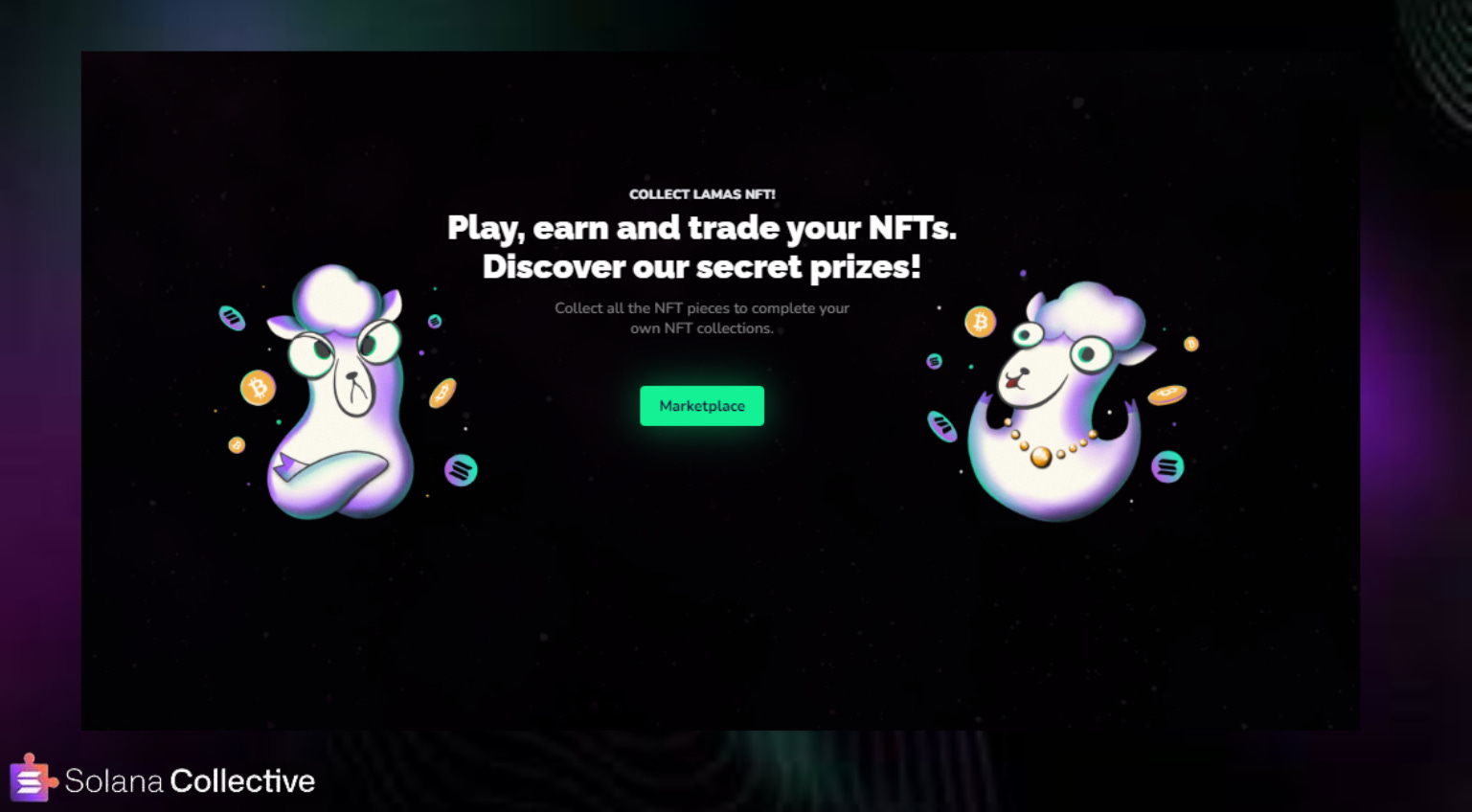
Yielding
Yielding in Lamas Finance refers to the various methods by which users can earn returns or rewards on their cryptocurrency and NFT holdings within the platform. Here’s an overview of how yielding works and what it entails:
1. Farming
Users add liquidity to get LP tokens, then stake the LP tokens to earn interest with an extremely high APY.
Farming profits are from Lamas Treasury. In the initial stage, there are two farming pairs provided on Lamas Finance: LMF/ USDC, LMF/SOL
2. Swapping
Swapping in Lamas Finance refers to the process of exchanging one cryptocurrency or NFT for another within the platform. This process is typically facilitated through decentralized exchanges (DEXs) or dedicated swap features within the Lamas Finance ecosystem. Here’s how swapping works and its significance:
How Swapping Works in Lamas Finance:
Decentralized Exchange (DEX) Integration:
Lamas Finance may integrate with decentralized exchanges, allowing users to swap tokens directly on the platform. This integration provides a seamless and secure way to trade cryptocurrencies without needing a centralized intermediary.
NFT Swapping:
Users can swap NFTs directly with each other. This could be facilitated through a peer-to-peer marketplace where users can list their NFTs for trade and negotiate swaps.
Liquidity Pools:
Swapping often relies on liquidity pools where users provide pairs of tokens to facilitate trading. When you swap one token for another, you are essentially trading with the liquidity pool.
User Interface:
The swapping feature is usually accessible via a user-friendly interface where users can select the tokens or NFTs they want to swap, specify the amount, and execute the transaction. The platform handles the rest, ensuring the swap is completed efficiently and securely.
3. Liquidity adding
Adding liquidity in Lamas Finance involves contributing assets (typically pairs of tokens) to a liquidity pool within a decentralized exchange (DEX) or DeFi protocol on the platform. This process helps facilitate trading and provides liquidity for users who want to swap tokens. In return, liquidity providers earn a share of the transaction fees and potentially additional rewards. Here's an overview of how it works:
How Adding Liquidity Works in Lamas Finance:
Liquidity Pools:
A liquidity pool is a smart contract that holds pairs of tokens. Users can trade against these pools, which provide the liquidity needed for transactions to occur.
Providing Liquidity:
Users can add liquidity by depositing pairs of tokens into a pool. For example, a user might provide equal values of Lamas Finance tokens (LMF) and Ethereum (ETH) to a LMF/ETH pool.
Liquidity Provider (LP) Tokens:
In exchange for providing liquidity, users receive LP tokens, which represent their share of the pool. These tokens can be used to withdraw their share of the pool at any time, including any earned fees.
Earning Rewards:
Liquidity providers earn a portion of the transaction fees generated by trades that occur in the pool. Additionally, Lamas Finance may offer extra incentives such as governance tokens or yield farming rewards.
Example Scenarios for Adding Liquidity in Lamas Finance:
Token Pair Example:
A user wants to add liquidity to the LMF/ETH pool. They deposit $500 worth of LMF and $500 worth of ETH into the pool. In return, they receive LP tokens representing their contribution.
Earning Fees:
Every time someone trades LMF for ETH or vice versa, a small transaction fee is collected. These fees are distributed proportionally to all liquidity providers in the pool. The user who added liquidity will earn a share of these fees based on their contribution.
Yield Farming:
Lamas Finance might run promotions where providing liquidity to specific pools can earn users additional rewards, such as Lamas Finance governance tokens or exclusive NFTs. Users can maximize their returns by participating in these opportunities.
Benefits of Adding Liquidity:
Passive Income:
Liquidity providers earn a share of the transaction fees, providing a steady stream of passive income based on the trading activity in the pool.
Incentives:
Additional rewards, such as governance tokens or exclusive NFTs, can make liquidity provision even more attractive.
Supporting the Ecosystem:
By adding liquidity, users help ensure that the platform has sufficient liquidity for smooth trading operations, benefiting the entire ecosystem.
Flexibility:
LP tokens can be used in various DeFi activities, such as staking or as collateral for loans, providing additional ways to earn returns on provided liquidity.
Steps to Add Liquidity:
Select a Pool:
Choose a liquidity pool to contribute to, such as LMF/ETH or any other pair available on the platform.
Deposit Tokens:
Deposit the required pairs of tokens into the pool through the platform’s interface.
Receive LP Tokens:
Get LP tokens representing your share of the pool. These tokens can be used to withdraw your assets along with any earned fees.
Monitor Earnings:
Track the transaction fees and additional rewards earned from providing liquidity. Withdraw your assets when needed by redeeming the LP tokens.
Adding liquidity in Lamas Finance enhances the platform's trading capabilities and offers users multiple ways to earn returns, making it a crucial component of the ecosystem.
Benefits and Incentives of yielding
Passive Income: Yielding provides a way for users to earn passive income on their holdings, incentivizing long-term participation in the platform.
Increased Engagement: Yield opportunities encourage users to actively participate in the ecosystem, whether by staking, providing liquidity, or engaging in other activities.
Economic Stability: Yield mechanisms help maintain liquidity and stability within the Lamas Finance ecosystem, supporting its overall health and growth.
4. Staking
Staking in Lamas Finance involves locking up your cryptocurrency or NFTs within the platform to support its operations, security, and various protocols. In return for staking, users earn rewards, which can come in the form of additional tokens, governance rights, or other incentives. Here’s an overview of staking in Lamas Finance:
How Staking Works in Lamas Finance:
Locking Tokens/NFTs:
Users lock their Lamas Finance tokens (LMF) or specific NFTs in a staking contract or pool for a predetermined period. During this period, the staked assets are typically non-transferable and cannot be used for other purposes.
Earning Rewards:
In return for staking, users earn rewards, which might include additional LMF tokens, governance tokens, or other benefits. The reward rate can vary depending on the amount staked, the duration of the staking period, and the overall participation in the staking pool.
Supporting the Network:
Staking helps support the Lamas Finance network by securing the blockchain, validating transactions, or providing liquidity. It also helps stabilize the token supply and incentivizes long-term holding.
Example Scenarios for Staking in Lamas Finance:
Staking LMF Tokens:
A user stakes 1,000 LMF tokens in a staking pool for six months. In return, they earn a 10% annual percentage yield (APY) in additional LMF tokens. After the staking period, they receive 50 LMF tokens as a reward.
NFT Staking:
A user stakes a complete 3-star NFT collection in a special staking pool. This collection is locked for three months, and in return, the user earns rare NFTs or additional LMF tokens. The rarity and value of the staked NFTs can influence the reward rate.
Governance Participation:
Users who stake LMF tokens may receive governance tokens, allowing them to vote on platform decisions, proposals, and changes. This encourages active participation in the platform's development and decision-making processes.
Benefits of Staking:
Earning Passive Income:
Staking allows users to earn passive income in the form of staking rewards. This incentivizes long-term holding and participation in the platform.
Network Security and Stability:
By staking their tokens, users help secure the network and contribute to its stability. This is particularly important in decentralized finance (DeFi) platforms, where network security is paramount.
Enhanced Token Utility:
Staking adds utility to the LMF tokens and NFTs, providing users with more reasons to acquire and hold these assets.
Community Engagement:
Staking encourages active participation in the platform's ecosystem, fostering a more engaged and committed community.
Steps to Stake:
Choose a Staking Pool:
Select a staking pool or contract that suits your goals. This could be a general LMF token staking pool or a specific NFT staking pool.
Deposit Tokens/NFTs:
Lock your LMF tokens or NFTs in the chosen staking pool. The platform’s interface will guide you through the process.
Earn Rewards:
Monitor your staking rewards over time. Rewards are typically distributed periodically, such as daily, weekly, or monthly.
Withdraw Staked Assets:
After the staking period ends, you can withdraw your staked assets along with any earned rewards. Some platforms may offer flexible staking options where you can withdraw at any time, while others might have fixed terms.
Staking in Lamas Finance provides users with an opportunity to earn rewards while supporting the platform's operations and stability. It enhances the overall utility and value of the tokens and NFTs within the ecosystem.
TOKENOMICS
It refers to the economic structure of a cryptocurrency or token, including its supply, distribution, and utility within an ecosystem. It determines how tokens are earned, spent, and incentivized, driving the network’s growth and sustainability. Strong tokenomics ensures balanced incentives for participants, promoting long-term value and stability.
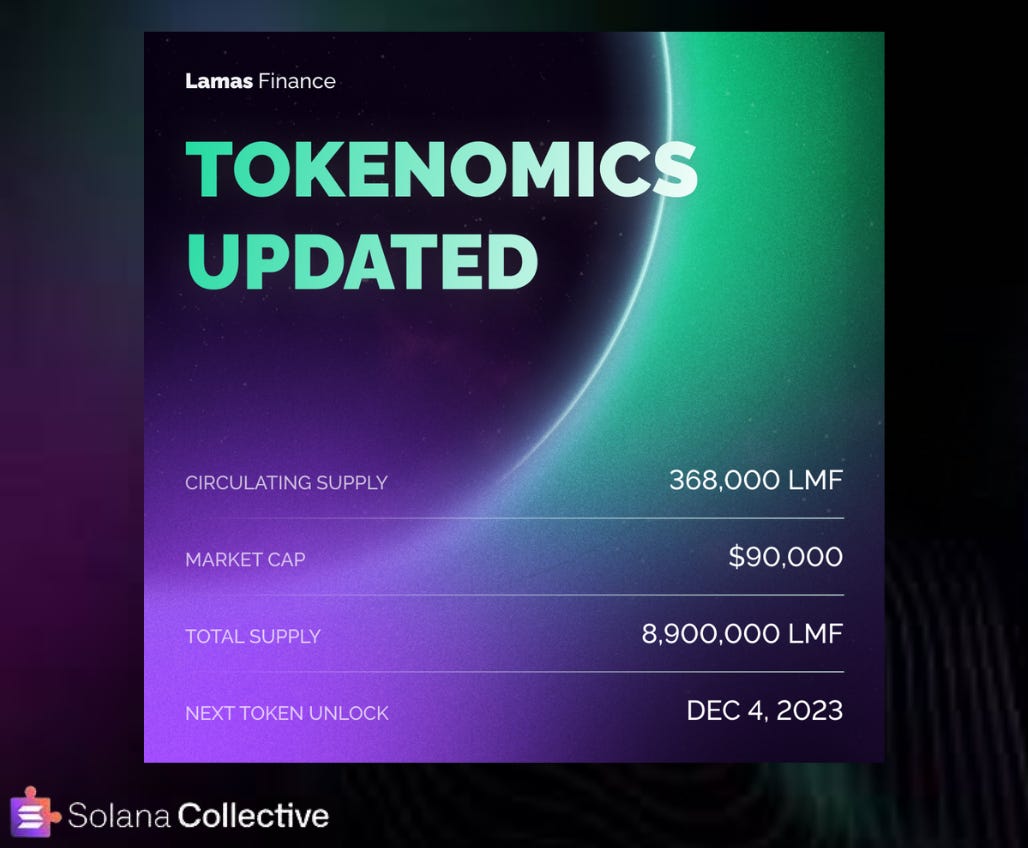
In Lamas Finance it refers to the economic model and distribution strategy of the platform's native token, often referred to as LMF (Lamas Finance token). Tokenomics encompasses the token's issuance, utility, distribution, and mechanisms that drive its value and usage within the ecosystem. Here's a detailed overview of the tokenomics in Lamas Finance:
Key Components of Tokenomics in Lamas Finance:
Token Issuance:
Total Supply: The maximum number of LMF tokens that will ever exist. This can be a fixed supply or subject to a predetermined inflation schedule.
Initial Distribution: How the initial supply of LMF tokens is allocated, including allocations for the team, advisors, early investors, public sales, and community rewards.
Utility:
Transactions: LMF tokens can be used to pay for transaction fees within the Lamas Finance ecosystem.
Staking: Users can stake LMF tokens to earn rewards and participate in network security and governance.
Governance: LMF token holders can use their tokens to vote on platform proposals and changes, influencing the development and direction of Lamas Finance.
Yield Farming: LMF tokens can be used in yield farming pools to earn additional rewards.
NFT Interactions: LMF tokens may be required for purchasing, trading, or staking NFTs within the platform.
Distribution and Incentives:
Community Rewards: A portion of the LMF tokens is allocated for rewarding community activities, such as participating in platform events, referrals, and other engagement activities.
Liquidity Mining: Tokens are distributed as rewards to users who provide liquidity to decentralized exchanges or other liquidity pools.
Development Fund: Allocation for ongoing development, marketing, and partnership initiatives to support the platform's growth.
Mechanisms:
Burning: A mechanism to permanently remove tokens from circulation, often used to reduce supply and increase scarcity. For example, users might burn tokens to redeem specific rewards or access exclusive features.
Inflation: If the token supply is not fixed, an inflation schedule might be in place to mint new tokens over time, typically to incentivize staking or liquidity provision.
Deflationary Mechanics: Mechanisms that reduce the total supply over time, such as token burns or buybacks.
Example of Token Allocation:
Team and Advisors: 20%
Early Investors: 10%
Public Sale: 15%
Community Rewards: 30%
Liquidity Mining and Yield Farming: 15%
Development Fund: 10%
Benefits of Tokenomics:
Incentivizes Participation: By offering rewards and incentives, tokenomics encourages users to actively participate in the platform, whether through staking, providing liquidity, or engaging in governance.
Supports Network Security: Staking mechanisms help secure the network and maintain its integrity.
Drives Adoption: Utility-driven tokenomics ensures that the LMF token has various use cases, driving demand and adoption within the ecosystem.
Encourages Long-Term Holding: Reward structures and staking incentives encourage users to hold onto their tokens, reducing market volatility and promoting price stability.
Example of Token Usage:
Governance Voting: A user stakes LMF tokens to gain voting power and participates in a vote to determine a new feature implementation on the platform.
Yield Farming: A user provides LMF tokens to a liquidity pool and earns additional LMF tokens as a reward for their contribution.
NFT Purchase: A user uses LMF tokens to buy a rare NFT within the Lamas Finance marketplace.
1. LMF
LMF, the native utility token of the Lamas Finance platform, is used for rewarding users and is utilized in all of the system’s features. LMF token holders will enjoy many benefits such as rewards from staking and farming programs, reducing taxes when playing games, and participating in project management.
Key metrics
Token Name: Lamas Finance
Ticker: LMF
Blockchain: Solana
Token Standard: Solana
Total Supply: 10,000,000 LMF
2. Lamas Treasury
It is a reward pool designed to incentivize users for playing games, collecting NFTs, and engaging in Lamas Finance's DeFi activities such as staking and farming. It is structured to be sustainable and efficient, ensuring a steady supply of LMF tokens (with zero inflation) while providing significant incentives for LMF holders and users of Lamas Finance services.
Initially funded with 25% of the total LMF token supply (for more details, see Token Allocation). Thereafter, it will be sustained by the following sources:
Taxes collected from games
Taxes on NEFT transactions in the Lammas market
The Lamas Foundation Team will adjust the rewards for NFT redemption, staking, and farming to ensure that no more than 10% of the Lamas Treasury is used to reward users each month. Monthly revenue will be used to offset these expenses.
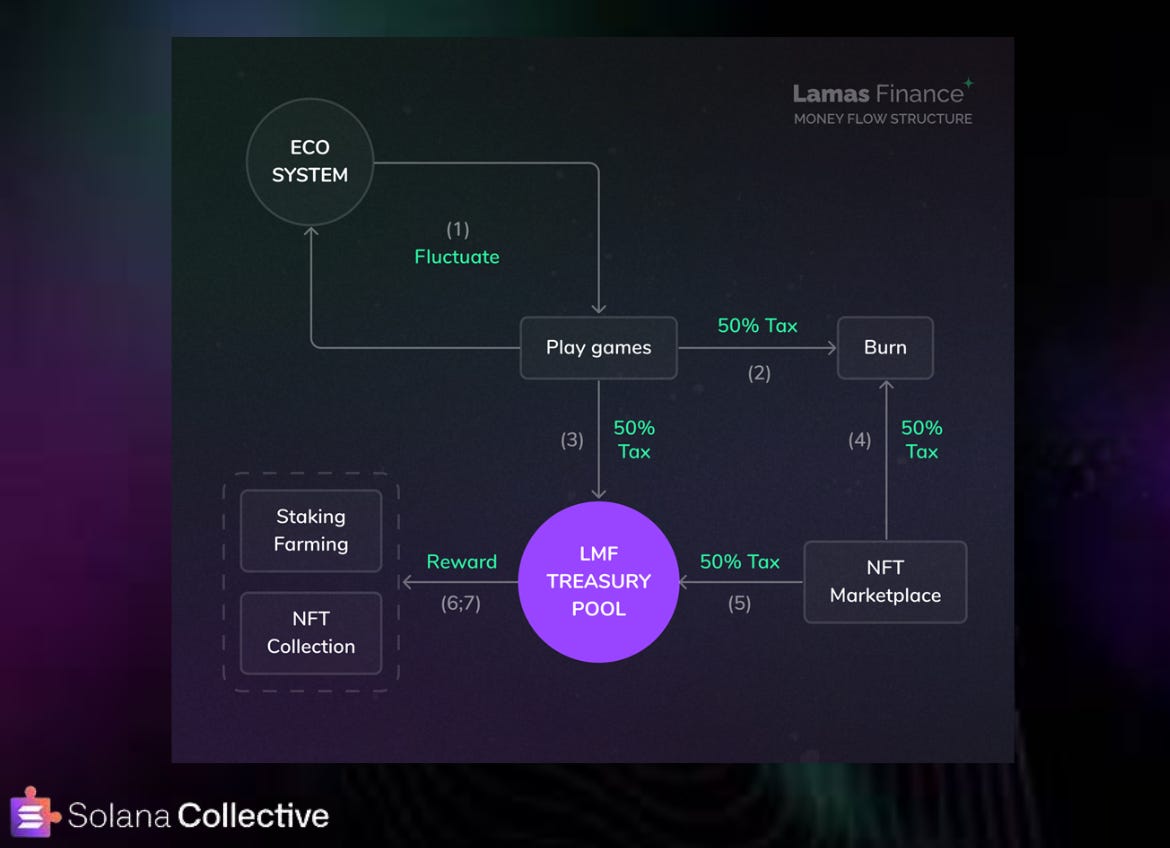
3. Money Flow
When participating in games, users interact with the Ecosystem Pool (1). If they win, their profits will be taxed. This tax will be divided into two parts: burned (2) or remitted to the Lamas Treasury (3).
Additionally, NFT pieces collected during gaming can be traded, with 5% of the transaction value deducted as tax. This tax will also be divided into two parts: burned (4) or remitted to the Lamas Treasury (5).
Finally, the Lamas Treasury will award prizes to users who redeem complete NFT collections (6) and provide interest to stakers and farmers (7).
4. Token Allocation
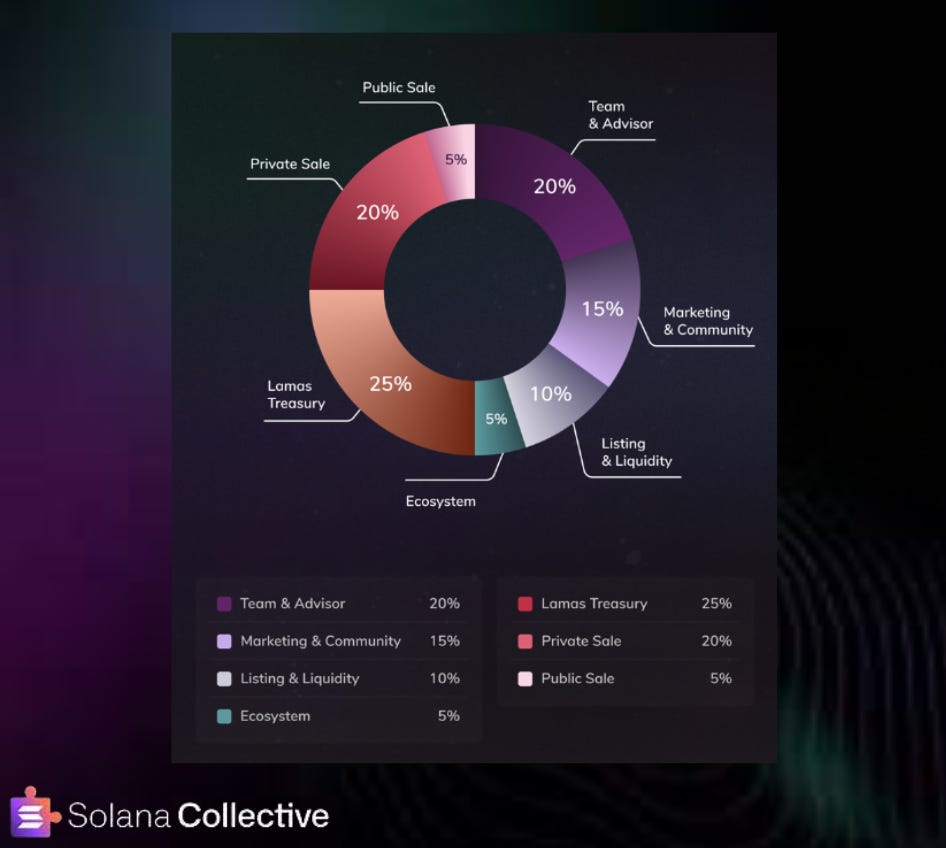
5. Vesting Plan
Team & Advisor: 6-month cliff, followed by linear vesting over the next 12 months.
Marketing & Community: 20% distributed in the first month, with the remaining 80% distributed during upcoming events within 12 months from the TGE.
Listing & Liquidity: 10% available at TGE for DEX listing, with 90% reserved for future DEX and CEX listings.
Ecosystem: Allocated for in-game usage (amount may fluctuate).
Lamas Treasury: Allocated for yield and incentives.
Private Sale: 10% available at THE, with linear vesting over the next 12 months.
Public Sale: 40% available at THE, with 60% vesting linearly over the next 2 months.
6. Sale Detail
Private Sale
Allocation: 20%
Token for sale: 2,000,000 LMF
Price: $0.1 - $0.2
Public Sale
Allocation: 5%
Token for sale: 500,000 LMF
Price: $0.3 - $0.4
Dex Listing (Raydium Liquidity)
Circulating supply: 400,000 LMF (1% liquidity + 1% private + 2% public = 4%)
Price: $0.4
Initial market cap: $160,000
Fully diluted market cap: $4,000,000
Conclusion of tokenomics
In Lamas Finance is designed to create a sustainable and engaging ecosystem where the LMF token serves multiple purposes, including transactions, staking, governance, and incentivization. The strategic distribution and utility of the token help drive user engagement, support network security, and ensure the long-term growth and stability of the platform.
Uses of Lamas Finance
Lamas Finance provides multiple uses for different user needs:
1. Decentralized Finance (DeFi):
Staking: Users can stake LMF tokens to earn rewards and participate in network governance. This helps secure the platform and provides users with passive income.
Yield Farming: Users can provide liquidity to various pools and earn additional LMF tokens as rewards, benefiting from trading fees and incentive programs.
Lending and Borrowing: LMF tokens can be used as collateral for loans or to lend assets, enabling access to liquidity without selling assets.
2. Gaming:
In-Game Currency: LMF tokens can be used within Lamas Finance’s games for transactions, such as purchasing in-game items or participating in special events.
NFTs: Players can collect, trade, or sell NFTs related to the games. NFTs can represent unique items, characters, or achievements within the games, with their value often tied to the game's ecosystem.
3. NFT Marketplace:
Trading: Users can buy, sell, or trade NFTs on the Lamas Finance marketplace. This provides a platform for discovering and acquiring unique digital assets.
NFT Redemption: Users can redeem complete NFT collections for rewards, adding a gamified element to the process and incentivizing collection and engagement.
4. Community Engagement:
Governance: LMF token holders can vote on proposals and changes to the platform, contributing to the decision-making process and shaping the future of Lamas Finance.
Rewards and Incentives: The Lamas Treasury and other reward mechanisms provide incentives for community participation, such as gameplay, NFT collection, and DeFi activities.
5. Investment Options:
Token Trading: Investors can trade LMF tokens on decentralized exchanges (DEXs) or centralized exchanges (CEXs), allowing them to speculate on the token’s value or diversify their portfolio.
NFT Investment: Investors can acquire and hold NFTs with the potential for appreciation in value, driven by their rarity or significance within the Lamas Finance ecosystem.
6. Economic Participation:
Liquidity Provision: By adding liquidity to various pools, users can earn rewards and help maintain the platform’s operational efficiency, contributing to the overall liquidity of the ecosystem.
Roadmap and Future Plans
Lamas Finance has laid out an ambitious roadmap to enhance its offerings and expand its user base. The key milestones include:
2023:
Q2: Completion of the whitepaper, launch of the official website, and initiation of community engagement.
Q3: Testing of four games, public sale of tokens, and listing on decentralized exchanges.
Q4: Introduction of farming and staking features, the launch of an NFT marketplace, and the release of "Play to Earn NFT."
2024 and Beyond:
Plans to introduce governance functions, a lending protocol, and support for multi-chain functionalities to broaden the platform's reach and usability.
Continuous development of new DApp games to keep the community engaged and attract new players.
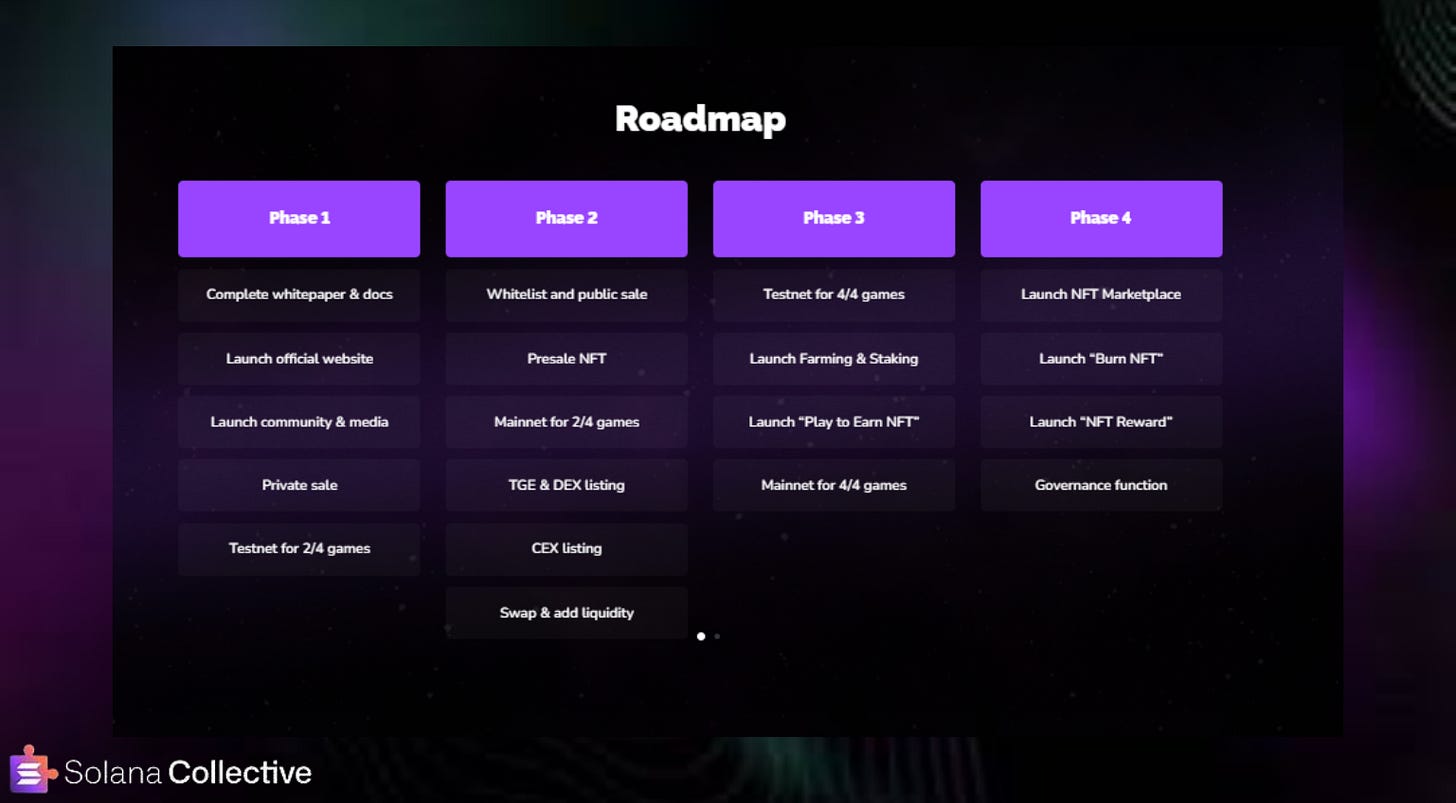
RoadMap Lamas Finance
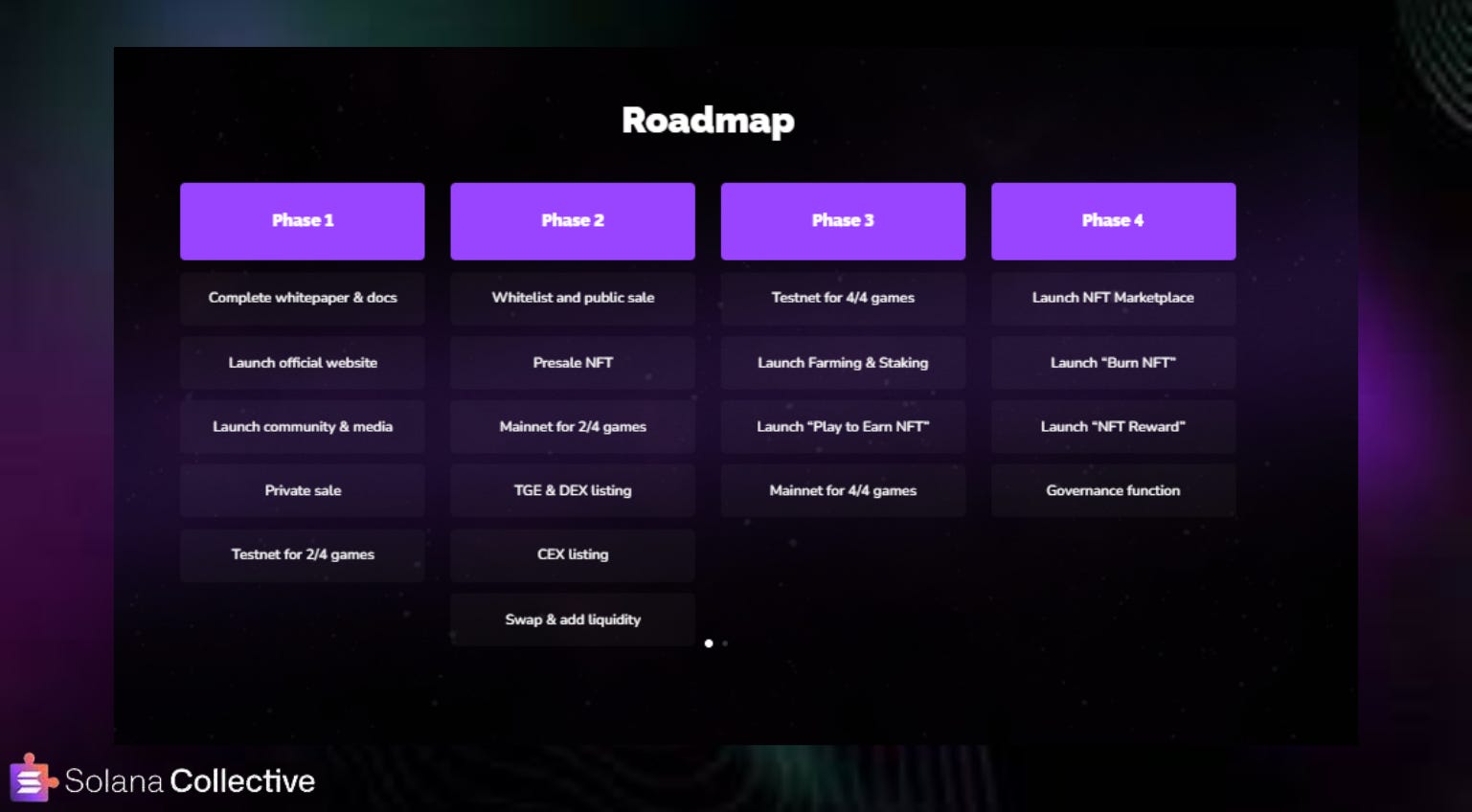
Community and Engagement
The platform actively seeks feedback from users to improve its offerings and ensure that it meets their needs. It aims to create a loyal user base that contributes to the platform's growth and success. The integration of social media and community platforms allows users to stay updated on the latest developments, participate in discussions, and engage with other players. This sense of community is essential for building trust and encouraging participation in the platform's various activities.
Challenges and Opportunities
Like many projects in the DeFi and gaming space, Lamas Finance faces challenges, including market volatility and competition from other platforms. However, the unique combination of gaming and DeFi positions it well to capitalize on the growing interest in both sectors. The platform's focus on transparency, user experience, and innovative features provides it with a competitive edge. As the DeFi space continues to evolve, Lamas Finance is well-positioned to adapt and grow, offering users new and exciting ways to engage with blockchain technology.
Conclusion
It represents a significant step forward in the integration of gaming and decentralized finance. By the capabilities of the Solana blockchain, it offers users a unique platform where they can enjoy genuine blockchain gaming experiences while also benefiting from essential DeFi functions. Lamas Finance is Continue with growth in DeFi and blockchain gaming with a clear plan and strong community focus. As it expands, It aims to be a top platform, offering users the chance to earn, play, and engage in a decentralized ecosystem.
References
https://www.lamas.co/
https://docs.lamas.co/
https://idodar.com/listing/lamas-finance-lmf/
https://messari.io/project/lamas-finance/profile
https://icodrops.com/lamas-finance/
https://messari.io/project/lamas-finance/price-chart
https://www.bybit.com/en/coin-price/lamas-finance/
https://cryptorank.io/ico/lamas-finance
https://lamasfinance.medium.com/
https://www.coingecko.com/en/coins/lamas-finance
https://solana.com/ecosystem/lamasfinance